Poker odds tables: outs, pot odds and hand frequencies
Three quick references for hold'em and five-card hands, every figure computed by counting cards rather than copied: how often a draw comes in, whether the pot is paying enough to chase it, and how rare each five-card hand is. A short calculator does the pot-odds comparison for you.
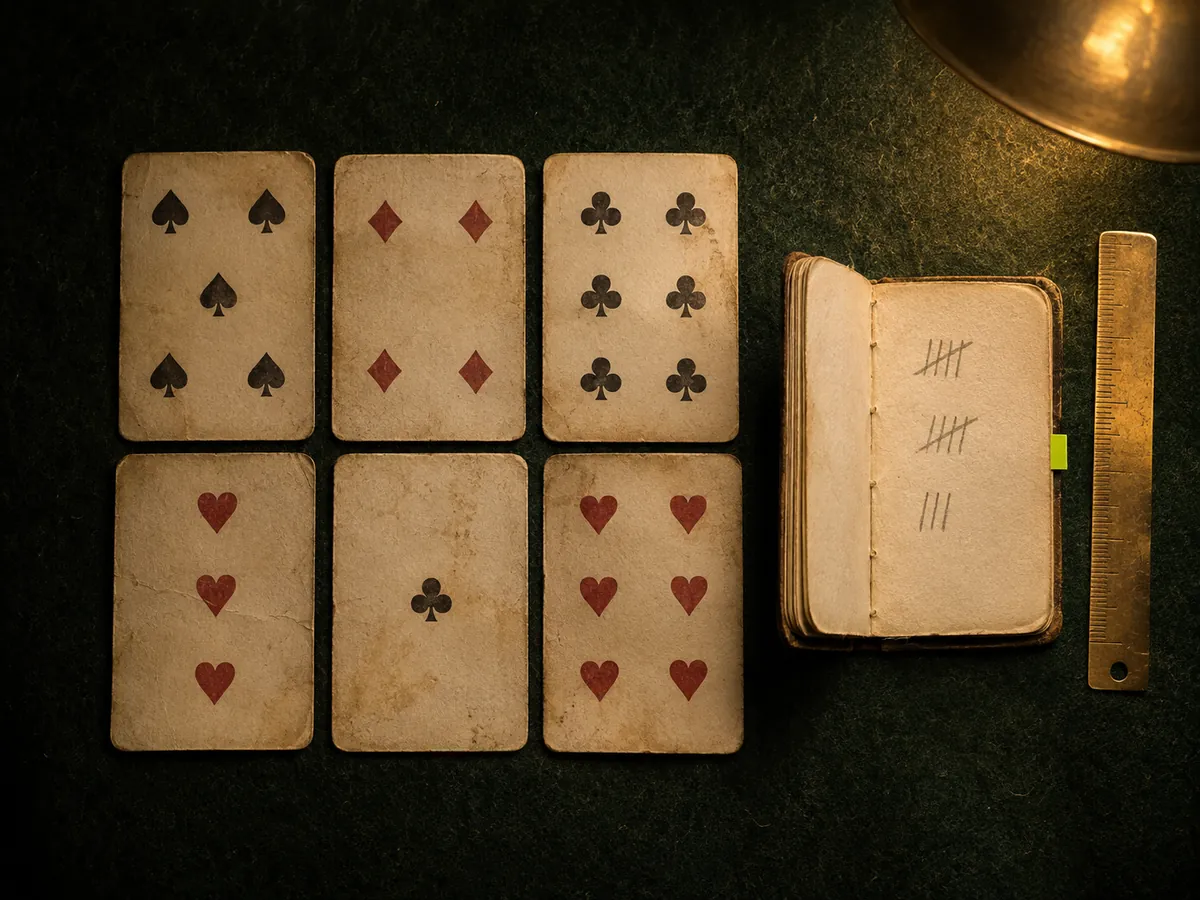
- Flush draw on the flop
- 35.0% to hit by the river
- Pocket pair
- 1 in 17 5.88% of starting hands
- Set on the flop
- 11.8% holding a pocket pair
Outs and pot-odds checker
EXACT CARD COUNTINGOnly worth it if you will see both cards for this one price.
Counting outs assumes each out really wins. Discount outs that could also give an opponent a better hand.
How wrong is the rule of 4?
After the flop you have seen five cards (your two and three on the board), so 47 are unseen. After the turn, 46. The table gives the exact chance for each number of outs and how far the popular rule of 4 and 2 is off. The rule is fine for small draws and overstates big ones.
| Outs | Turn only (1 of 47) | River only (1 of 46) | Turn or river | Rule of 4 | Rule error |
|---|---|---|---|---|---|
| 1 | 2.1% | 2.2% | 4.3% | 4% | -0.3 pts |
| 2 | 4.3% | 4.3% | 8.4% | 8% | -0.4 pts |
| 3 | 6.4% | 6.5% | 12.5% | 12% | -0.5 pts |
| 4 | 8.5% | 8.7% | 16.5% | 16% | -0.5 pts |
| 5 | 10.6% | 10.9% | 20.4% | 20% | -0.4 pts |
| 6 | 12.8% | 13.0% | 24.1% | 24% | -0.1 pts |
| 7 | 14.9% | 15.2% | 27.8% | 28% | +0.2 pts |
| 8 | 17.0% | 17.4% | 31.5% | 32% | +0.5 pts |
| 9 | 19.1% | 19.6% | 35.0% | 36% | +1.0 pts |
| 10 | 21.3% | 21.7% | 38.4% | 40% | +1.6 pts |
| 11 | 23.4% | 23.9% | 41.7% | 44% | +2.3 pts |
| 12 | 25.5% | 26.1% | 45.0% | 48% | +3.0 pts |
| 13 | 27.7% | 28.3% | 48.1% | 52% | +3.9 pts |
| 14 | 29.8% | 30.4% | 51.2% | 56% | +4.8 pts |
| 15 | 31.9% | 32.6% | 54.1% | 60% | +5.9 pts |
| 16 | 34.0% | 34.8% | 57.0% | 64% | +7.0 pts |
| 17 | 36.2% | 37.0% | 59.8% | 68% | +8.2 pts |
| 18 | 38.3% | 39.1% | 62.4% | 72% | +9.6 pts |
| 19 | 40.4% | 41.3% | 65.0% | 76% | +11.0 pts |
| 20 | 42.6% | 43.5% | 67.5% | 80% | +12.5 pts |
one card to come: P = outs / unseen
two cards to come: P = 1 - C(47 - outs, 2) / C(47, 2)
break-even share = call / (pot + call) pot includes the bet you face
Starting hands
| Event | Chance | Odds | Counting |
|---|---|---|---|
| Dealt any pocket pair | 5.88% | 1 in 17 | 6 pairs per rank, 13 ranks: 78 of 1,326 |
| Dealt a specific pair (e.g. two aces) | 0.452% | 1 in 221 | C(4,2) = 6 of 1,326 |
| Dealt two suited cards | 23.53% | 1 in 4.25 | 4 x C(13,2) = 312 of 1,326 |
| Dealt a specific unpaired hand (e.g. ace-king) | 1.21% | 1 in 82.9 | 4 x 4 = 16 of 1,326 |
| Pocket pair flops a set or better | 11.76% | 1 in 8.5 | 1 - C(48,3) / C(50,3) |
| Suited hand flops a flush | 0.84% | 1 in 119 | C(11,3) / C(50,3) |
| Suited hand flops a flush draw (exactly two of the suit) | 10.94% | 1 in 9.1 | C(11,2) x 39 / C(50,3) |
Five-card hand frequencies
One deck deals 2,598,960 different five-card hands; here they are sorted into classes and counted. The counting formula for each class is in the last column.
| Hand | Combinations | Chance | Odds against | Formula |
|---|---|---|---|---|
| Royal flush | 4 | 1.54e-6 | 649,739.0 : 1 | 4 suits x 1 |
| Straight flush (not royal) | 36 | 1.39e-5 | 72,192.3 : 1 | 10 x 4 - 4 |
| Four of a kind | 624 | 0.0240% | 4,164.0 : 1 | 13 x C(48,1) |
| Full house | 3,744 | 0.1441% | 693.2 : 1 | 13 x C(4,3) x 12 x C(4,2) |
| Flush | 5,108 | 0.1965% | 507.8 : 1 | 4 x C(13,5) - 40 |
| Straight | 10,200 | 0.3925% | 253.8 : 1 | 10 x 4^5 - 40 |
| Three of a kind | 54,912 | 2.1128% | 46.3 : 1 | 13 x C(4,3) x C(12,2) x 4^2 |
| Two pair | 123,552 | 4.7539% | 20.0 : 1 | C(13,2) x C(4,2)^2 x 11 x 4 |
| One pair | 1,098,240 | 42.2569% | 1.4 : 1 | C(4,2) x 13 x C(12,3) x 4^3 |
| High card | 1,302,540 | 50.1177% | 1.0 : 1 | C(52,5) - all of the above |
Limits
- Outs tables assume the out wins when it lands. In real hands some outs also improve an opponent; count those as half or not at all.
- Pot odds look at this call only. Whether chasing pays overall depends on what you win when you hit and lose when you miss on later streets.
- Hand-versus-hand equities need the opponent's cards and a full enumeration; this page does not estimate them.
Questions people ask
- Why are there 47 unseen cards on the flop, not 45?
- Opponents' cards are unknown to you, so for your calculation they are still among the unseen cards. Each unseen card is equally likely to be the next one dealt.
- How accurate is the rule of 2 on the turn?
- Close: with one card to come the exact chance is outs / 46, about 2.17% per out, so the rule slightly understates it.
- Is a straight rarer than a flush?
- No, in five-card hands from one deck a flush (5,108 ways) is rarer than a straight (10,200 ways), which is why a flush ranks higher.
Updated . Found a wrong number? Tell us which inputs you used; corrections are listed on the method page.